
Changing your surname in French records from the US

French nationals in the US end up with mismatched names more often than they expect: one surname on the American birth certificate, another on the French record, a hyphen that appears on one and not the other. The US consular network lists several routes, and picking the right one saves months.
The page on surname changes was updated by the network on November 10, 2026.
Which route fits your case
| What you want | Route | Who handles it |
|---|---|---|
| Take your father's name, your mother's, or both | Simplified procedure | Your consulate |
| Use on your French record the name on your US birth certificate | Matching with foreign civil status | Central civil registry service (Nantes); the consulate if you cannot |
| Give a minor child a different surname | Joint declaration of both parents | Your consulate, in person |
| Record a name change ordered by a US court | Opposability check | Public prosecutor in Nantes |
| Change your name for a legitimate reason | Decree | Procedure on Service-Public.fr |
Hear about the next consular tour
We’ll email you about upcoming consular tours and new procedure guides. No ads, and you can unsubscribe at any time.
The simplified procedure
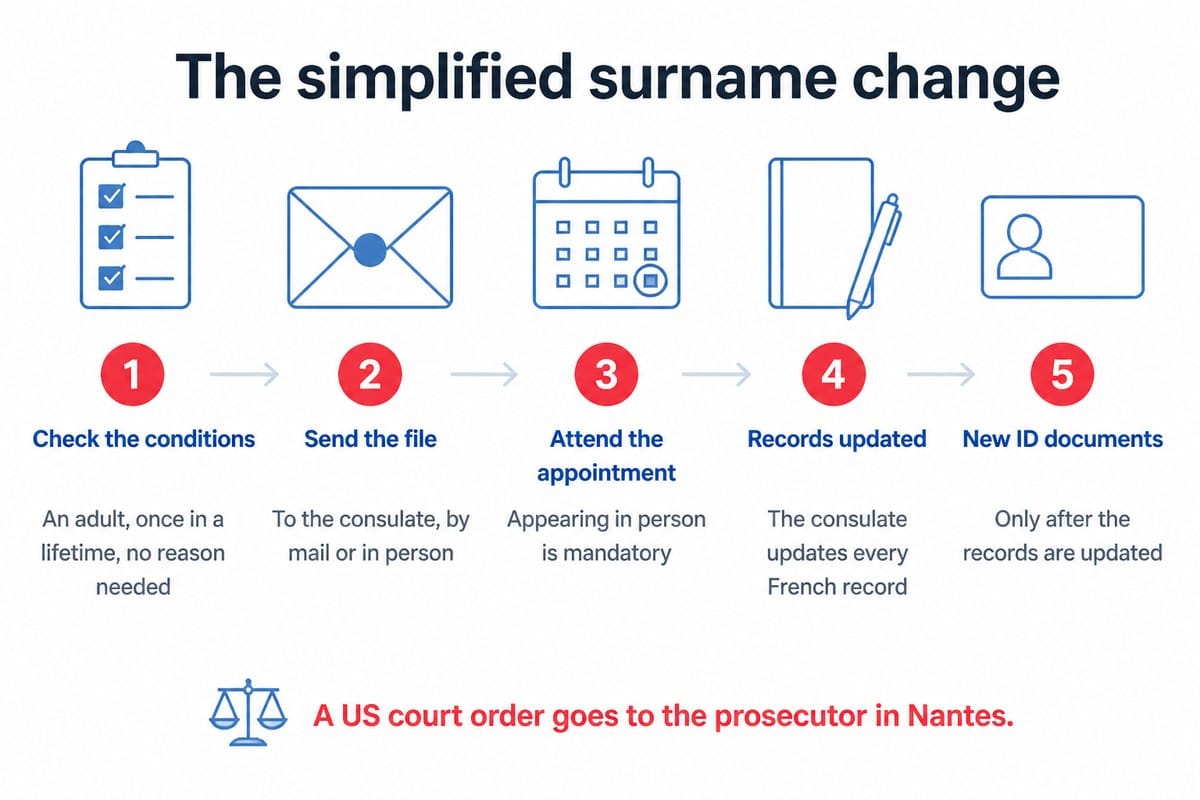
Since July 1, 2022 (law no. 2022-301 of March 2, 2022), any adult can ask to carry their father's name, their mother's name, or both side by side in the order they choose, one name from each parent at most.
Three conditions apply: you must be an adult, you can use it only once in your life, and you do not have to give a reason.
The change also reaches your children who carry your name or part of it, so they have to be listed in the request. It applies automatically to children under 13. From 13, the child's consent is needed, on page 5 of the CERFA form.
You send the complete file to the consulate by mail or drop it off in person. The consulate then offers you an appointment, and you have to appear in person.
Once it validates the request, the consulate updates every French record involved: your birth and marriage records, your spouse's birth record if the marriage is still in force, your children's birth records.
- The completed name-change application form
- A stamped A5 envelope (100 grams) addressed to you
- A front-and-back copy of your national ID card and/or passport
- Full copies of your birth and marriage records, less than 3 months old
- Recent proof of address in your name, or the host’s sworn statement, proof of address and ID
- Full copy of your spouse’s or PACS partner’s birth record
- Full copies of your children’s birth records, and marriage records if any
- Your livret de famille
- Bulletin no. 3 of the criminal record if the request covers an adult or a child over 13
Only after the records are updated can you ask for new identity documents, such as the French passport or the national ID card.
Matching your US birth name
Since the law of November 18, 2016, anyone can ask for the name on their French birth record to be changed to the name on their foreign birth certificate. It is the route for someone whose American certificate carries a different surname from the one France transcribed.
This file goes by mail to the central civil registry service, at the address printed on the form. If that is not possible, you can send the complete file to the consulate.
Attach the application form (adult or minor, plus the consent form for a child over 13), a copy of your valid ID and your foreign birth certificate with a French translation.
Add full copies of all your French civil records less than three months old: marriage, spouse's or partner's birth record, your children's records. If you hold several nationalities, include a birth record and a valid ID for each one.
A different surname for a minor child
Parents can give their child a surname different from the one on the birth record when only one parent was recorded at the birth declaration, or when the two parents were not recorded at the same time.
The declaration can be made at any time before the child turns 18, and both parents sign it in person at the consulate. A child over 13 has to consent.
When a US birth is transcribed, the registrar copies the foreign surname automatically unless you say otherwise. For parents who want another name, the network points to a joint choice of name for a child under 3 (married parents, or both parents recorded by the day of the declaration) or, if the parents are not married and at least one parent was recorded after the birth declaration, a name change before 18.
The details of the transcription itself are in our guide to registering a US birth.
A name change ordered by a US court
A change granted by an American court does not appear in the French records on its own. The request goes to the public prosecutor at the judicial court of Nantes for people born abroad, who checks that the foreign decision complies with French law. The network says plainly that consular services are not competent.
Write to: Monsieur le Procureur de la République, Tribunal Judiciaire, Service civil, 44921 Nantes Cedex.
Send the full decision (original or certified copy, apostilled or legalized where needed, with a sworn translation), proof of the parties' nationality when the case was filed, and full copies of the French records that will carry the mention.
Add a copy of your valid ID and a recent proof of address. It is the same logic as a US divorce, which also goes through Nantes.
Cases that change the route
Frequently asked questions
Can I change my surname at the French consulate?
Yes, through the simplified procedure if you are an adult and have never used it, and for a joint declaration for a minor child. A change ordered by a US court goes to the prosecutor in Nantes instead.
I am an adult and want to carry only my mother's name. Is that possible?
Yes. Since July 1, 2022, an adult can choose the father's name, the mother's name, or both side by side in the order they prefer.
Do my children's names change too?
Those who carry your name change with you. It is automatic under 13; from 13 the child has to consent.
Is there a fee?
The network's page lists none. Budget for the documents: recent full copies of your records, the translation and, for a court order, the apostille.
Do I have to go to the consulate?
For the simplified procedure, yes: after you send the file you are offered an appointment, and appearing in person is mandatory.
The simplified procedure can be used once in a lifetime: check which route fits before you file.Official sources: Changement de nom de famille, updated November 10, 2026.
We are not an official body. frenchconsulates.us collects and checks information on French consular offices in the United States, with no link to the French government.
No appointments are booked here and nothing is charged for. Check the detail with the office that covers you.