
French census and JDC for young French people in the US

Every French national living abroad who turns 16 has to be recorded in the citizen census (recensement citoyen) with the consulate where they live.
It keeps them in order with the French national service and produces two things: a census attestation and, later, a call to the Defense and Citizenship Day (Journée Défense et Citoyenneté, JDC).
Both papers matter more than they seem. French state exams and the driving test ask for them up to age 25.
Who has to do it, and when
The rule depends on how you became French and on your age today. The US network's page sets it out like this:
| Your situation | What you have to do |
|---|---|
| French from birth, turning 16 | Be recorded from your 16th birthday |
| French from birth, between 16 and 25 and never recorded | Regularize with the same step, up to age 25 |
| Became French between 16 and 25 | Be recorded within the month after acquiring nationality |
| Over 25 | Released from military obligations: no census |
A teenager born in Houston to a French mother is in the first row. A 19-year-old who just received French nationality by declaration is in the third, and the clock is short: one month.
Hear about the next consular tour
We’ll email you about upcoming consular tours and new procedure guides. No ads, and you can unsubscribe at any time.
Registered or not: the step changes
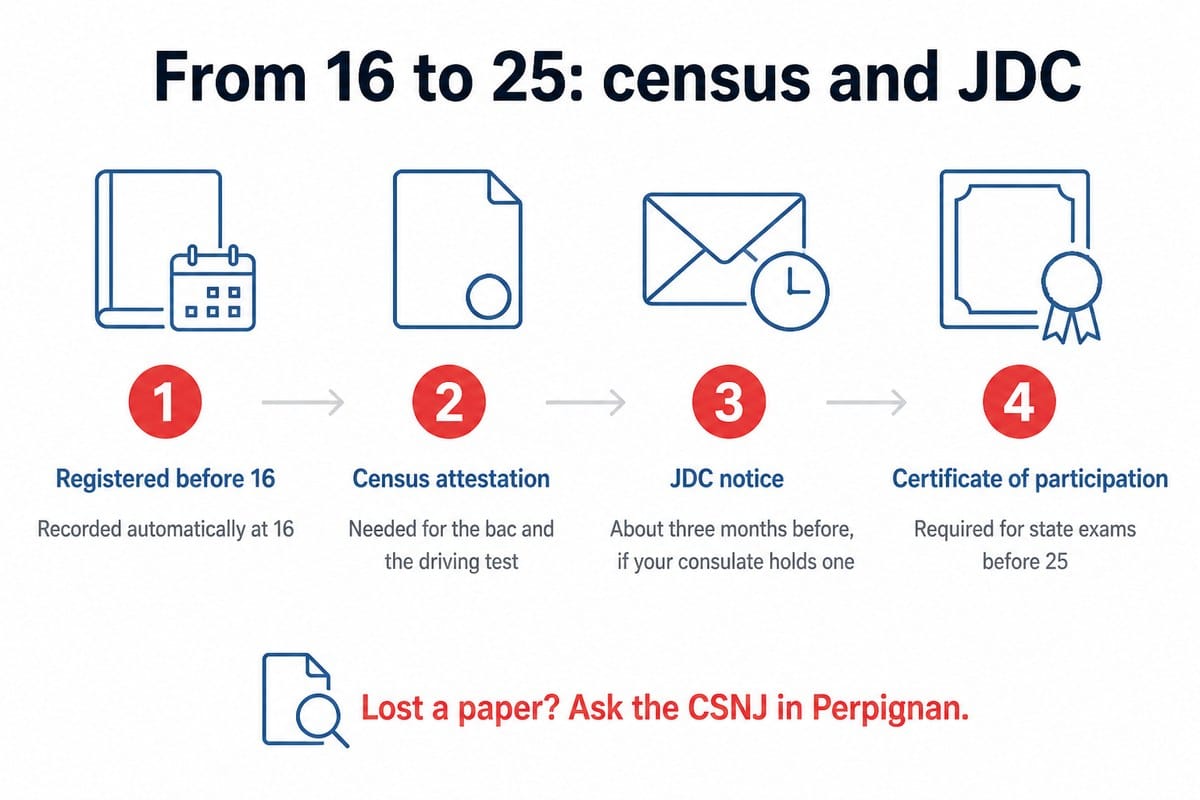
If the young person is listed in the Registre des Français établis hors de France, the consulate records them automatically at 16. Nobody has to send anything.
The catch is the address. The attestation is sent using the details in the Registre, so check that the email and postal address on file are current before the birthday.
If they are not registered, the network asks them to come forward to the consulate on their own, at the latest before turning 16. Registering them in the Registre before that birthday also works, since registered young people are recorded automatically at 16.
- Check the young person is in the Registre, or contact the consulate if they are not
- Make sure the contact details on the Registre are up to date
- Declare every other nationality they hold
- Keep the census attestation once it arrives
What the census attestation is for
After the census, the consulate issues the attestation de recensement. It is required to sit French state exams and competitive exams, such as the baccalauréat and the driving test, and to take part in the JDC.
If you plan to sit the test for a French driver's license before 25, this is one of the papers to have at hand.
The Defense and Citizenship Day (JDC)
The JDC is mandatory for every French national recorded in the census between 16 and 25. Living in the US changes how it works:
- If your consulate holds a JDC session, you receive a notice about three months before the date.
- If your consulate does not hold one, you can ask for a provisional JDC deferral attestation.
- If you move to France before 25, you will have to do the JDC there, through the CSNJ in Perpignan.
After the session you receive a certificate of participation. Like the census attestation, it is required for state exams (CAP, BEP, baccalauréat, driving test) before 25, and for a military career.
Lost the attestation or the certificate
For a lost or stolen paper, the network's page does not send you back to the consulate. You ask for an attestation of administrative status (attestation de situation administrative) from the Centre du Service National et de la Jeunesse (CSNJ) in Perpignan, which handles French nationals living abroad.
Dual nationals
Many young French people in the US are also American. When registering or reporting to the consulate, the network asks you to state every other nationality, because you may also be subject to the military obligations of those countries.
The consulate then explains the options, in particular where France has signed a bilateral or multilateral agreement with the other country.
Cases that change the route
For a young person who also needs French papers, the next steps are usually the French passport and, if they were born in the US, the birth transcription, which usually comes first.
Frequently asked questions
Is the census mandatory for French people living abroad?
Yes. Every French national residing abroad who reaches 16 has to be recorded with the consular post of their place of residence.
Do I have to do anything if my child is in the Registre?
No. Registered young people are recorded automatically at 16. Just keep the contact details on the Registre current so the attestation arrives.
Is there a JDC in the United States?
That depends on the consulate. If yours holds a session, you get a notice about three months ahead; if not, you can ask for a provisional deferral attestation.
Does the census cost anything?
The network's page lists no fee for the census or for the JDC.
Where do I get a replacement attestation?
From the CSNJ in Perpignan, which issues an attestation of administrative status to French nationals living abroad.
Registered in the Registre before 16? The census is automatic; just keep your address up to date.Official sources: Recensement citoyen à l’étranger - Journée Défense et Citoyenneté (JDC), updated February 13, 2026.
We are not an official body. frenchconsulates.us collects and checks information on French consular offices in the United States, with no link to the French government.
No appointments are booked here and nothing is charged for. Check the detail with the office that covers you.