
Registering a birth abroad
Registration of a birth abroad is what puts a child on the Japanese family register. Until that happens the child has no koseki entry, and without a koseki entry there is no Japanese passport.
The deadline that matters
Where a child born abroad also acquires another nationality, the registration has to include the reservation of Japanese nationality, and it has to be filed within the period Japanese law sets. Missing it has consequences that are hard to undo.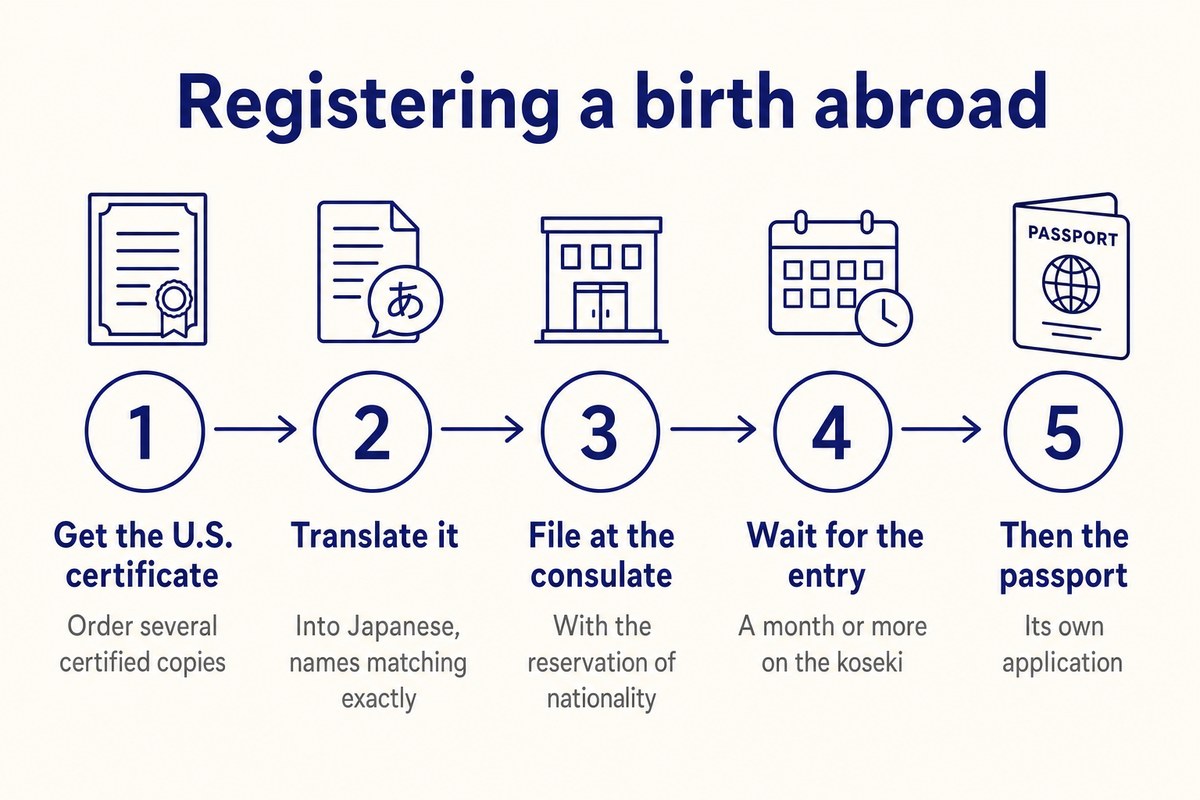
This is the point in the whole process where the consequences of delay are worst, and it is the one people most often discover late. If a child has just been born, this is the paperwork to deal with first.
What the consulate needs
After you file
The documents are forwarded to the municipality of the registered domicile in Japan, which makes the entry. That is the month or more. Nothing that depends on the child being on the register, a passport included, can move until it is done.
Where you file it
Through the Japanese consulate whose district covers where you live. The districts are not obvious and three are split, so check the state pages of this site before you drive: a family in Bakersfield files in San Francisco, and one in Palmdale files in Los Angeles.
The translation
The U.S. birth certificate needs a Japanese translation, and it is read by a municipal office in Japan rather than by the consulate. Names, dates and place names have to match the other documents in the file exactly.
Order several certified copies of the U.S. birth certificate at the outset. You will need one for the Japanese registration and others for passports, schools and the social security file.What follows the registration
Once the entry appears on the koseki, the child can be issued a Japanese passport, which is its own application and its own month.
And in due course, a child who holds two nationalities faces the choice of nationality. That is years away when the birth is registered, and it is worth knowing it is coming.