
Do US citizens need a visa for France?

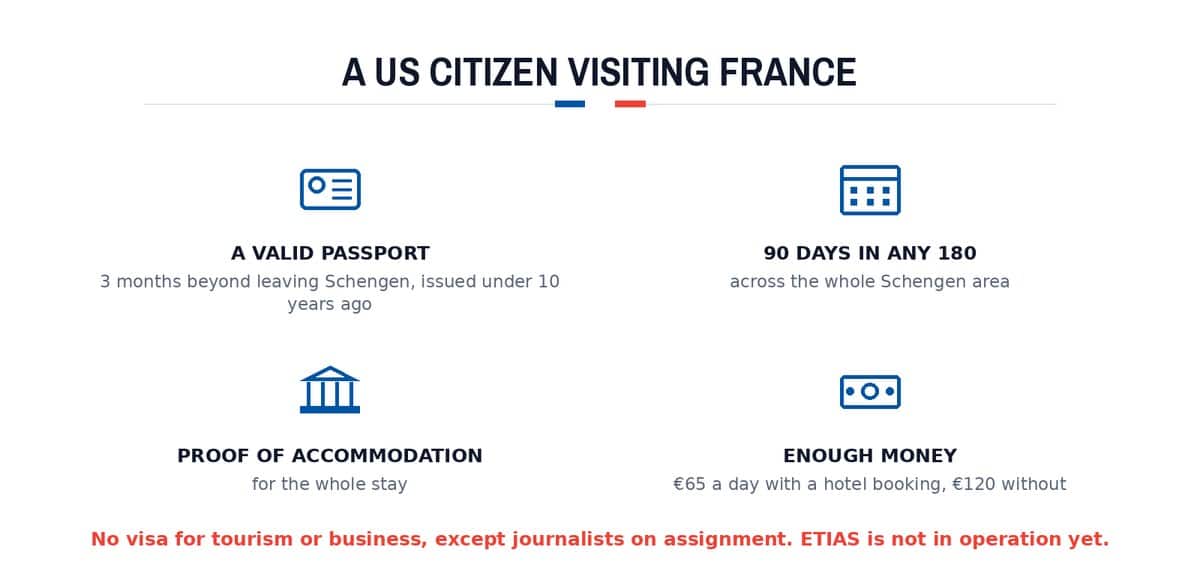
For a trip to France, a US citizen needs no visa for stays of up to 90 days, for tourism or business. The State Department's France page and France-Visas say the same, with one exception France-Visas spells out: journalists from the United States on assignment still need a visa.
Beyond 90 days, a long-stay visa is required before you leave.
The 90-day rule
The limit is 90 days in any 180, counted across the whole Schengen area, not France alone. It applies with or without a visa, and the European Commission publishes an online calculator for checking past and planned stays.
What to carry
The State Department asks for a passport valid three months beyond the date you leave the Schengen area, with one blank page for stamps, and notes that the 12-page US emergency passport is not valid for entry into France.
France-Visas adds that the passport must have been issued less than ten years ago.
| Item | Detail |
|---|---|
| Visa | None for up to 90 days in any 180 |
| Passport validity | 3 months beyond your exit from Schengen |
| Blank pages | At least 1, for stamps |
| US emergency passport | Not valid for entry into France |
| Cash to declare | 10,000 euros or more |
| ETIAS | Not in operation yet; EUR 20 when it starts |
- A US passport valid 3 months beyond your exit date
- A return or onward ticket
- Proof of accommodation for the whole stay
- Proof of resources and travel insurance
At the border you can be asked for proof of accommodation for the whole stay, enough money, insurance covering medical costs and repatriation, and a return ticket. France-Visas puts the minimum at 65 euros a day with a hotel booking and 120 euros a day without one.
Cash of 10,000 euros or more must be declared on entry and exit.
EES and ETIAS
The Entry/Exit System, EES, records travelers from outside the EU each time they cross the external border, with a face image and fingerprints; the consulates' page says it came into service progressively from October 12, 2025. The EU's EES site explains who it applies to and who it does not.
ETIAS is a travel authorization, similar to the American ESTA, that visa-exempt travelers will need. The EU's site says the application fee will be 20 euros and that it is not in operation yet.
The consulates' ETIAS page, last updated in October 2025, says it “will enter into service at the end of 2026”. The EU's own ETIAS site, read on October 5, 2026, says it is not in operation and that the start date will be announced several months ahead.
Go by the EU site, and never pay a website that sells ETIAS today. (sources: 1, 2)
Count the days: 90 in any 180, across the whole Schengen area.Official sources: U.S. Department of State, France travel page (Internet Archive capture of 12 June 2026); France-Visas, visa de court séjour; France-Visas, votre arrivée en France; ETIAS - Aller en Europe; ETIAS, official EU website.
Details checked against the official pages on October 6, 2026.
frenchconsulates.us is a private guide. We do not represent the French State and take no part in any consular service.
The information comes from official sources that sometimes disagree with one another, and is reviewed regularly. Confirm before you travel.