
Japan work visa
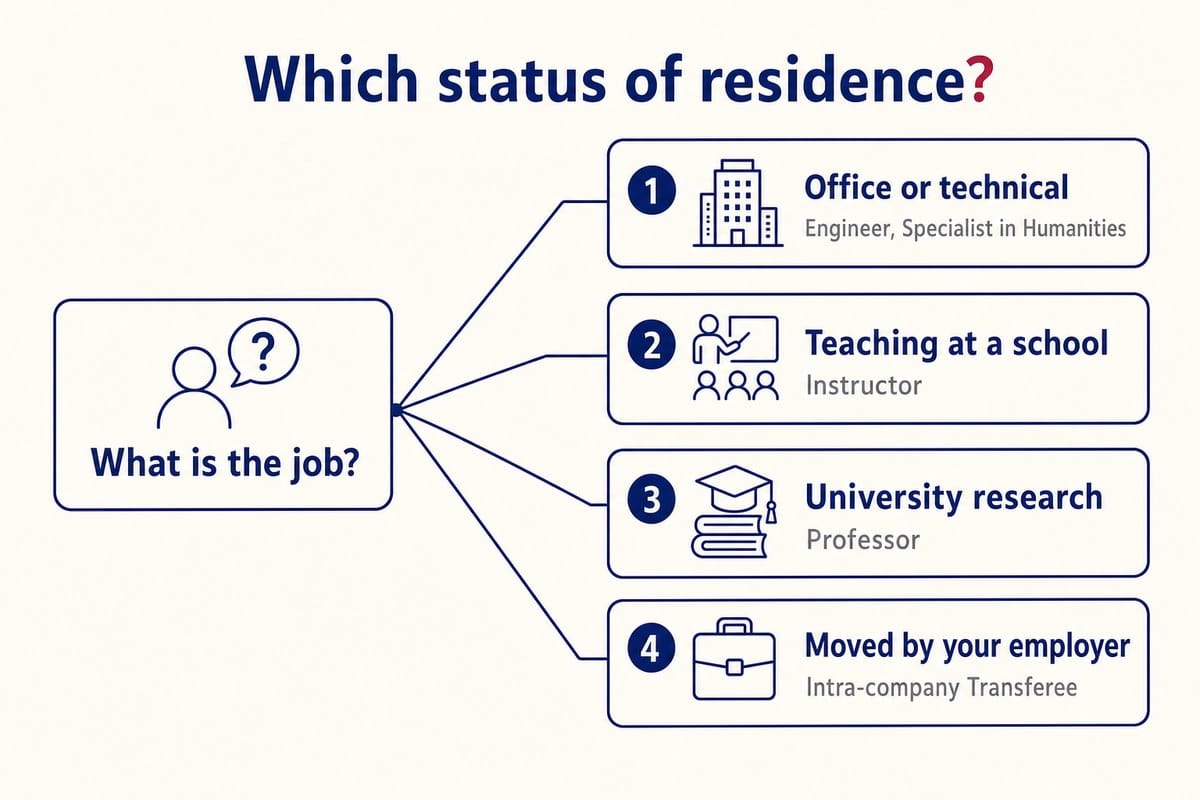
Japan grants the right to work through a status of residence, granted for a category of activity: engineering, humanities and international services, teaching, skilled labour, intra-company transfer and others. The category follows the job, and changing job can mean changing status.
How the sequence runs
Your employer applies for the Certificate of Eligibility in Japan. When it arrives, you take it to your Japanese consulate here with your passport, the form and a photo. The visa is issued in a few working days, and free of charge for U.S. nationals.
Two things people get wrong
The first is arriving under the 90-day visa exemption intending to work. The exemption covers business without paid activities, and being paid is exactly what it excludes.
The second is assuming the status transfers between employers. Some do, some require notification, and some require a change of status applied for inside Japan.
The statuses people usually mean
| Status | Typical holder |
|---|---|
| Engineer / Specialist in Humanities / International Services | Most office and technical jobs |
| Instructor | Teachers at primary and secondary schools |
| Professor | University teaching and research |
| Intra-company Transferee | Moved by an employer already in Japan |
| Highly Skilled Professional | Points-based, with faster routes to permanent residence |
Changing employer
A status granted for one category of activity usually survives a move to a similar job, with a notification to immigration within 14 days. A move to a different category needs a change of status, applied for inside Japan and granted before you start.
Working outside your status, even briefly, is the kind of problem that surfaces years later at a permanent residence application.Your family
A spouse and children can accompany you on Dependent status, and each needs their own Certificate of Eligibility. Dependent status permits limited part-time work only with separate permission.