
Koseki: the Japanese family register
The koseki is the Japanese family register: the record where a household's births, marriages, divorces, adoptions and deaths are entered. Only Japanese nationals appear in it, which is why a certified copy also works as proof of Japanese citizenship.
Two kinds of copy, and they are not interchangeable
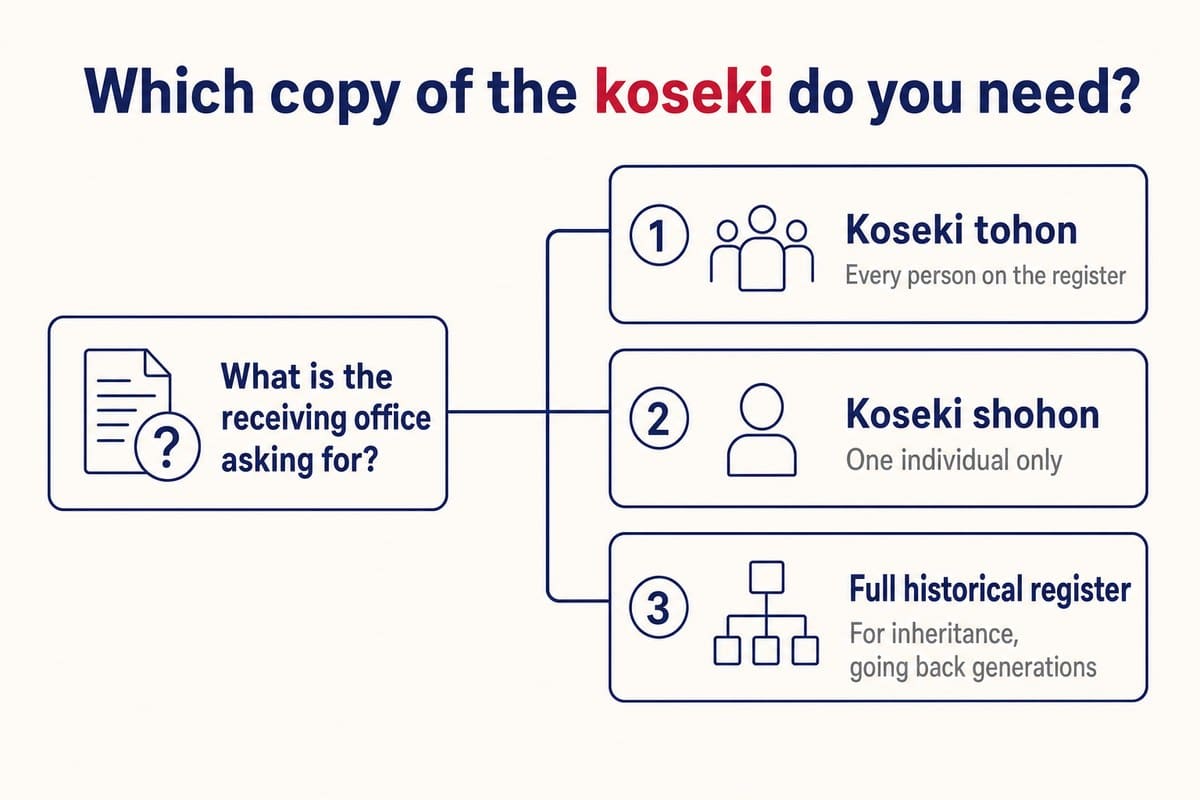
| Name | What it shows | When you need it |
|---|---|---|
| Koseki tohon | Every person on the register | Passport applications, most consular files |
| Koseki shohon | One individual only | Where only your own record is required |
How fresh it has to be
Most consular applications require a copy issued within the past three to six months. A passport application specifies six. An older copy is refused even if nothing on the register has changed.
Where it comes from
From the municipal office of your honseki, the registered domicile. That is not where you were born and not where you live: it is an address chosen and recorded in the register, and it can be anywhere in Japan.
If you do not know it, a relative on the same register usually does, or an old passport application may record it. The consulate cannot look it up.
What is actually on it
The register records births, marriages, divorces, adoptions, recognitions of parentage and deaths, along with the registered domicile and the head of the register. It is a record of a family line rather than of a household's current address, which is what the residence record does.
Why it doubles as proof of nationality
Only Japanese nationals appear on a koseki. That is why consulates accept it as evidence of citizenship for a passport application, and why losing track of your honseki makes a passport renewal harder than it needs to be.
When a copy is not enough
Some applications require the full register including entries that have been removed, the joseki, particularly in inheritance matters where the line has to be traced. Ask the receiving institution which version it needs.
An inheritance file in Japan can require registers going back three generations, each ordered separately from a different municipality. Start earlier than feels necessary.The digital route
Japan has been connecting municipal registers so that copies can be obtained outside the honseki municipality. What is available changes, and it is worth asking your municipality directly what it will send abroad and how.