
How to apply for a Japanese visa in the U.S.
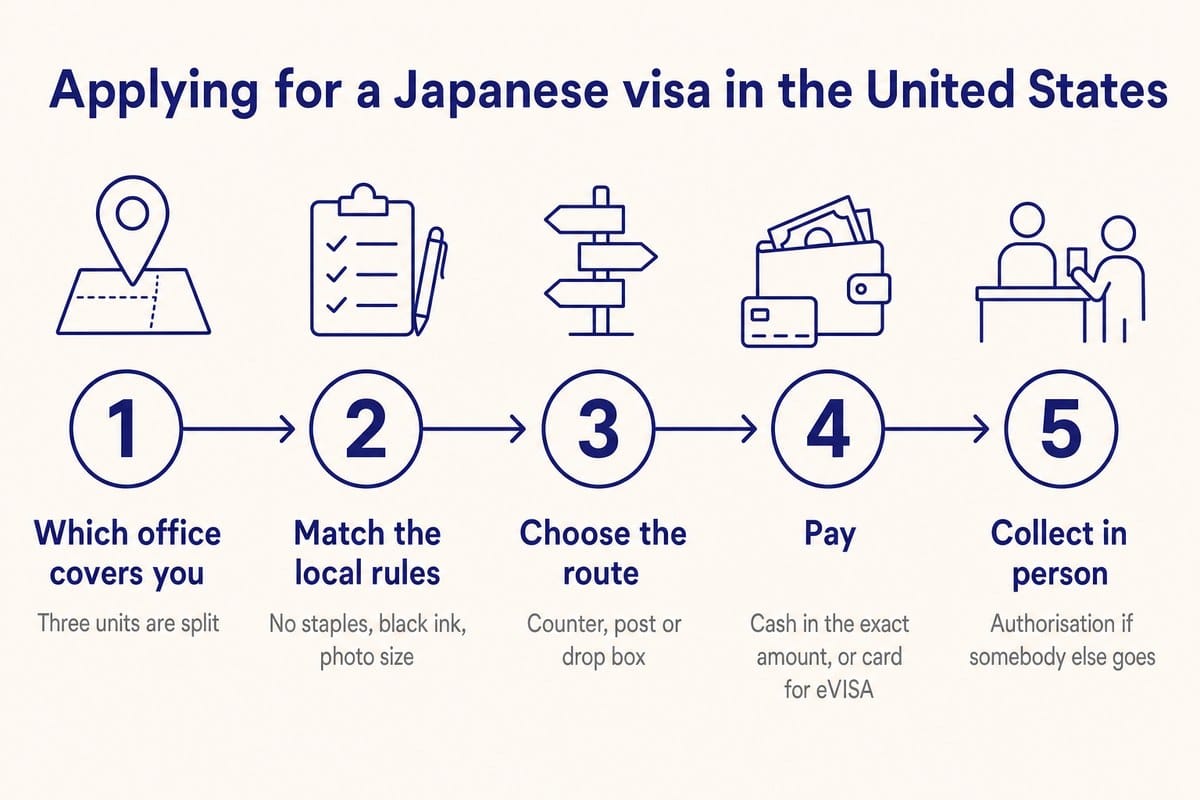
Applying for a Japanese visa in the United States has three parts: working out which office covers you, assembling a file that matches what that office asks for, and getting it there. The second part is where applications fail.
Find your consulate first
Japan divides the United States into eighteen consular districts and the boundaries are not intuitive. Three units are split: California and Connecticut by ZIP code, and Idaho by a north-south line that no office publishes.
Then match the file to the office
The core documents are the same everywhere: form, passport, photo, and whatever supports the purpose of the trip. The presentation is not. Houston asks for documents without staples. Several offices refuse photocopies that have been reduced. Others want the form printed in black ink.
Which office covers you
Japan divides the United States into eighteen districts, and three of them are split in ways that catch people out. The full map is on the state pages of this site, and the short version is that your state is not always your office: Nevada is San Francisco, West Virginia is New York, and Wyoming is Denver.
Applying to the wrong consulate does not usually produce a polite redirect. It produces a returned file and a lost week.
Postal applications
Several offices accept visa applications by post, which matters when the consulate is 500 miles away. The passport travels in both directions, so use a service with tracking and insurance, and include the prepaid return envelope the office specifies.
Not every office accepts postal applications for every visa type. Check the page of your own consulate rather than assuming, because the practice varies more than the requirements do.Collecting
Collection is usually in person, and if someone else is collecting for you, they need written authorisation. Reviewers at more than one consulate describe being turned away at that point, having driven a long way, over a piece of paper that is not mentioned on the official page.