
Japan visa requirements for U.S. residents
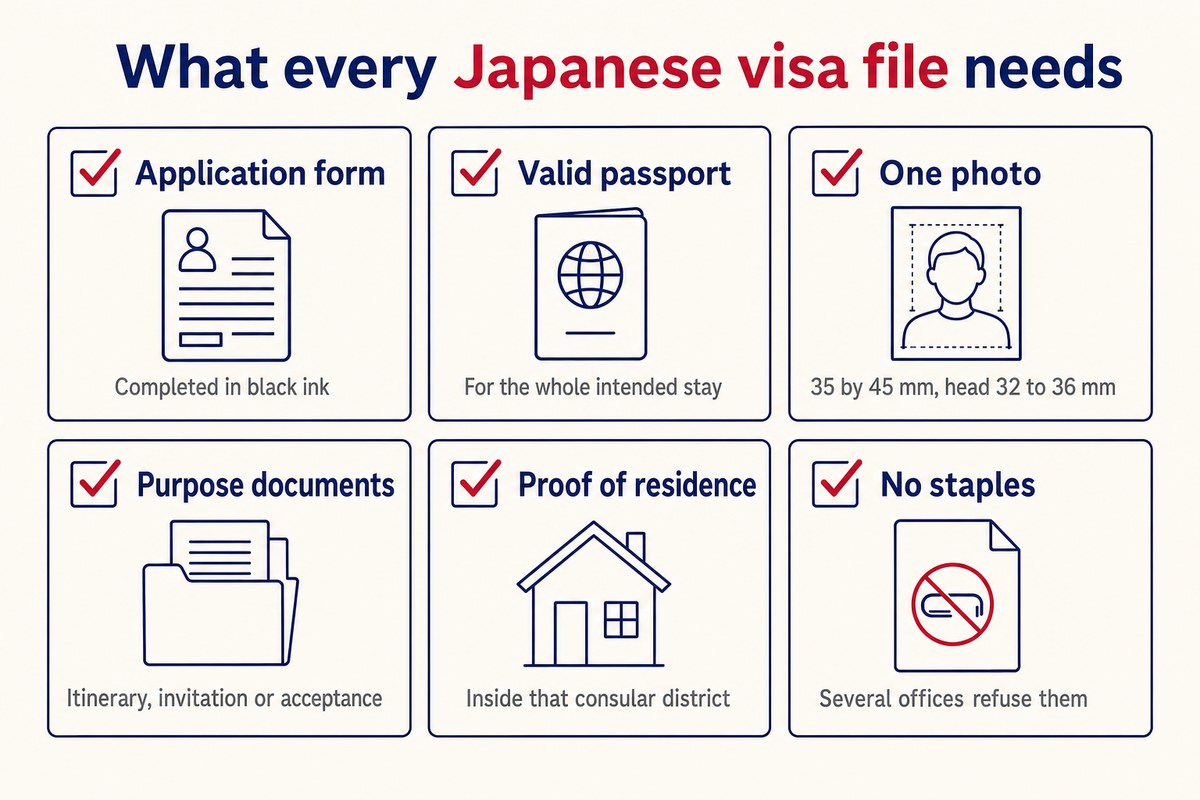
Japan publishes a common core of visa requirements and then lets each consulate add its own presentation rules. The core is short. The local rules are what catch people out.
The common core
What changes between offices
Photo size, whether photocopies are accepted, whether staples are allowed, whether the office takes postal applications, whether there is a drop box, and whether you can collect on someone else's behalf without written authorisation. None of that is standardised.
Fees
Japan revised its visa fees on 1 July 2026: single entry from 20 to 101 dollars, multiple entry from 40 to 201. U.S. and Canadian nationals are exempt from visa fees entirely, so those figures do not apply to them.
The photo, which is where files stall
The specification is precise: taken within the past six months, 35 × 45 mm or U.S. passport size, plain background, facing forward, no hat, no mask, no sunglasses. The head has to measure between 32 and 36 mm from the top of the hair to the chin.
School photographs are commonly refused, and so are prints from phone images that have been resized. A photo studio costs little and removes the most common reason for a second trip.
Translations
Supporting documents in English are generally accepted for a visa file. Documents for the family register, by contrast, usually need a Japanese translation, because they are read by a municipality in Japan rather than by the consulate.
A name transliterated inconsistently between two documents is one of the few errors that reliably sends a file back. Fix the spelling before you submit, not after.Proof that you live in the district
Every office asks for it, and a driving licence usually suffices. If you have recently moved between districts, bring evidence of the new address: the consulate you left will not forward the file for you.